PES POWER · Kazakhstan
UPS for lifts and escalators
A lift drive cannot be sized by nominal power alone. Starting, braking and control-system compatibility must be checked.
What to consider
- Drive type — variable-frequency or relay-controlled: starting currents depend on this.
- Regeneration — a lift returns energy to the grid during braking; the UPS must support this.
- Starting current — the UPS is selected by peak load rather than motor rating.
- Operating mode — emergency travel to the nearest floor or continued lift operation.
- Phases and lift manufacturer requirements — checked against the documentation.
How we select a solution
We collect site data, check the load and runtime, and agree equipment, installation and service. Final range suitability is confirmed by engineering assessment.
Regenerative loads and UPS energy backflow protection
During braking, a regenerative drive may return energy towards the UPS. This can raise the DC bus voltage, trigger overvoltage protection and interrupt power to the load.
According to KSTAR’s reply, among the requested EPOWER / HPM3300 / YMK3300 series, only the EP series equipped with an energy backflow protection device can operate with this load. An output transformer alone does not establish compatibility with regeneration.
FORTE EPOWER transformer-based UPS, 10–800 kVA
Series catalog and model specifications. For a regenerative lift or escalator drive, the EP/EPOWER configuration must be agreed with an energy dissipation device.
Open PDF catalogEPOWER models and specifications
Manufacturer’s energy backflow protection diagram
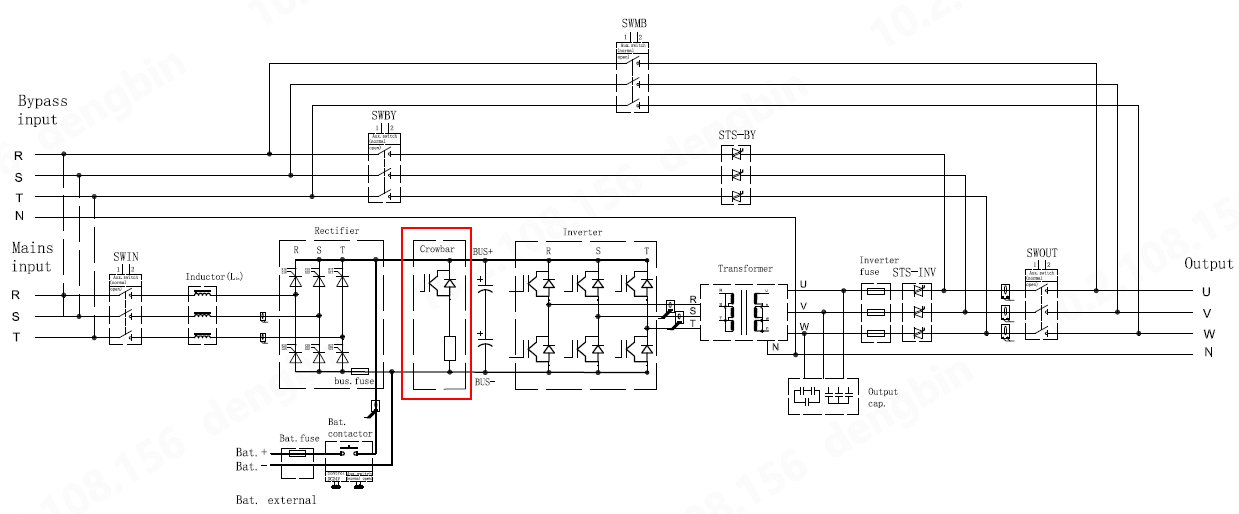
How it works
- The regenerative load returns energy towards the UPS, which may increase the DC bus voltage.
- Voltage and current sensing circuits monitor the system and detect energy backflow.
- The controller turns on the discharge IGBT, connecting the discharge resistor circuit to the DC bus.
- The resistor dissipates the returned energy as heat. This limits the bus voltage rise and prevents overvoltage protection from tripping within the selected device’s capabilities.
The UPS configuration and energy dissipation device rating are selected to match the drive characteristics and operating mode of the lift or escalator.
Experience and documents
PES POWER supplies UPS for shopping and business centers, hotels and residential complexes. Selection is based on lift equipment data and coordinated with the maintenance company.
Send project details · +7 701 872 24 87
Frequently asked questions
Can a lift UPS be selected only by motor power?
No. Starting currents and regeneration must be considered; otherwise the UPS will overload.
What does a UPS provide during a power outage?
Depending on the task, it brings the cabin to a floor and opens the doors, or powers the lift for the calculated runtime.
Is a UPS suitable for escalators?
Selection must account for starting conditions and regeneration. For regenerative loads, the manufacturer confirmed only EP equipped with energy backflow protection; operating limits are agreed for the specific configuration.
Can any transformer-based UPS supply a regenerative lift?
No. KSTAR’s reply confirms only the EP series with an energy backflow protection device among the requested series. The configuration and operating limits must be agreed with the manufacturer.
Where does the returned energy go?
A controlled IGBT connects the discharge circuit to the DC bus, and the discharge resistor dissipates the energy as heat.
What reverse power and duration can the system handle?
This depends on the selected dissipation device. Numerical limits and battery-mode conditions must be confirmed for the specific configuration.
Equipment and solutions
Floor-standing online UPS, 1–20 kVA: single-phase 1–10 kVA and 10–20 kVA models with three-phase input.
Rack-mounted online UPS, 6–10 kVA, with 2U/3U/4U height depending on the version, for server cabinets.
Three-phase online UPS, 10–40 kVA, for offices, healthcare and server rooms.
Three-phase online UPS, 60–200 kVA, for large facilities and industrial sites.
Modular UPS up to 1250 kVA with 50, 100 and 125 kVA modules and N+1 redundancy for data centers.
Three-phase UPS, 10–20 kVA, with a 3U height for rack or floor installation.
Transformer-based UPS, 10–800 kVA, for industry and challenging power grids.
VRLA batteries for UPS and backup power, with runtime calculations.
PES POWER: supply, installation and service of uninterruptible power systems in Kazakhstan since 2013.
Our own FORTE Green Power UPS and FORTE Battery Systems battery brands: who manufactures them and how they differ.
Articles on UPS selection, runtime calculations and battery service life.
Modular UPS with N+1 redundancy, batteries, generators and cooling.
Uninterruptible power for operating theatres, intensive care units, CT and MRI.
Uninterruptible power for warehouses and distribution centers: conveyors, sorting, server rooms and record-keeping systems.
Protection for control systems and process lines against shutdowns.
diagnostics and battery replacement in UPS from any manufacturer.
scheduled maintenance, repairs and service contracts.
Wokang and Silico generators in open, enclosed and containerized configurations.
single-phase and three-phase, from 3.5 to 1200 kVA.
turnkey KSTAR cabinet, modular and containerized data centers.
PES POWER projects completed in Kazakhstan.